
Produced by


Published January 24, 2023
Valves are a key part of new systems to safeguard operations.
Even in 2023, there’s still something otherworldly and futuristic about offshore drilling. Drilling deep under the ocean into the seabed to extract hydrocarbons that can be refined and turned into everything from oil to plastic products — it’s a testament to sheer ingenuity!
Offshore drilling and exploration occur in some of the harshest conditions. The risks are great for both human health and safety and environmental protection. Systems continually evolve to protect all aspects of the offshore production environment. Among these are continuous electronic monitoring systems of pumps and valves, as well as other production equipment. One of the most critical of these systems is the high intensity pressure protection system (HIPPS), sometimes called the last line of defense against an overpressure event at the wellhead.
Subsea High Intensity Pressure Protection Systems (HIPPS) have increasingly become a viable safety-instrumented system response to protect downstream flowlines, flowline jumpers and other subsea production system equipment from overpressure, as well as to protect the wider environment. As upstream systems continue to reach[JD1] higher pressure and higher temperature conditions due to deeper reservoir discoveries offshore, production costs to develop these wells have increased. Operators are turning to implementing HIPPS to extend the life of existing assets. HIPPS allows the high-pressure flowlines of an existing system to be safely derated between the manifold and host platform by reliably isolating the high-pressure product before the break of the lower pressure rated flowline. Proper HIPPS design focuses on the safety and reliability of the entire system from reservoir to topsides.
A typical HIPPS architecture consists of three pressure transmitters that constantly record the line pressure fed to a logic solver. In the event of an over-pressure condition, the logic solver initiates a shutdown operation of two consecutive fail-close valves installed on the same line, thereby shutting down fluid flow. Installation of a HIPPS may avoid blow off and flaring of carbon dioxide or other toxic gases, allowing companies to avoid incurring penalties for emissions. For SIL3 rated systems (see sidebar), at least two transmitters are required.
A SIL 3 quick exhaust valve in redundancy can be inserted into the system to open and dump hydraulic fluid, which reduces the pressure in the actuator that closes the HIPP valve[JD2] . By managing this fluid, this operation reduces over-pressurization and eliminates the potential of unplanned and unwanted release of hydraulic fluid.
Solenoids are typically used to control HIPPS valves, and can be powered hydraulically, pneumatically or with process gas. If the solenoid loses power, the valves automatically close. The time to close must be carefully set to prevent system or equipment damage.
HIPPS must be tested to meet multiple parameters, including the ability for the system valves not only to close, but to close in time to prevent catastrophic damage. Partial stroke testing is suitable for maintenance purposes, but full stroke tests must be undertaken to test the integrity of the system.
Well exit pressure can fluctuate, increasing exponentially throughout the lifecycle of the well, and can cause extremely hazardous conditions. Therefore, a HIPPS is one critical system for well safety. While operators may think that relief valves and flares that match the full capacity of wells are useful, this configuration can be very dangerous. HIPPS are better solutions to maintain safety of the system, with only a small relief valve required for manual depressurization of the system for maintenance.
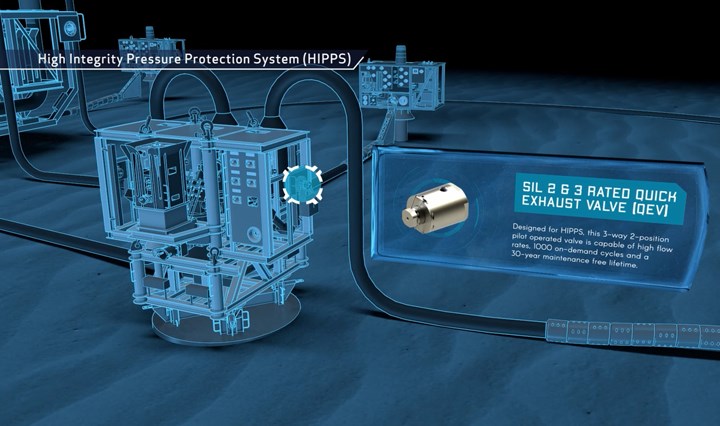
Rendering of a high-integrity pressure protection system (HIPPS).
Photo Credit: Gilmore
Well control systems prevent uncontrolled, catastrophic release of fluids from the subsurface formations. These systems are comprised of a blowout preventer (BOP) and an accumulator. The BOP, also called a BOP stack, is an assembly of valves that are placed in redundant configurations, that are capable of isolating and controlling the high-pressure fluids from the well. There are a variety of valves on BOPs, including an annular preventer, pipe rams, blind rams and shear rams.
An annular preventer is a doughnut-shaped element to prevent fluid from flowing and to close the annular space. Pipe rams are notched and used for specific-sized pipe, and work by closing around the pipe to seal the annular space. Blind rams are less common and work by isolating the drill pipe and the annular space by crushing the pipe and pinching it closed. Shear rams work by shearing off and closing the pipe. BOPs also have accumulators which store compressed energy to operate the blowout prevents even if the power to the rig above is not operational. BOPs often have more than one accumulator.
The Deepwater Horizon failure occurred when the shear ram on the system punctured the pipe and sent oil and gas surging to the surface for almost 90 days until it was contained and controlled. The subsequent investigation found that the shear ram was prevented from functioning properly because the pipe buckled. There were also instances of backup battery failures and miswiring that would have had an affect on the shear ram. Since the 2010 event, the American Petroleum Institute has published more than 200 new or revised standards and recommended practices for offshore drilling exploration and production.
Even with the risk of subsea drilling and exploration, the risks offshore that are more likely to cause harm or loss of life include aircraft crashes when transporting people or supplies to rigs; diving accidents; in-water vessel collisions; crane accidents, and other equipment failure or spills.
In addition to the Code, standard and regulatory changes, four major offshore operators founded the Marine Well Containment Company (MWCC) as an independent, non-profit with the mission of providing immediate response to any deepwater incidents in the Gulf of Mexico (GOM). MWCC offers containment systems and services to all member companies operating in the GOM, or to companies who name them as their well containment response provider on their drilling permit applications with BSEE. Another group of operators and non-operators have formed the Helix Well Containment Group (HWCG) to expand their capabilities in responding to subsea well containment to protect people, property and the environment.
To better prepare for a potential well control incident, four major operators founded the Marine Well Containment Company (MWCC)18 in 2010 as an independent, not-for-profit organization. MWCC’s overall mission is to be continuously ready in providing immediate response to a deepwater incident in the GOM to stop any unplanned discharges and capture the liquid aboard its vessels. With its membership now up to 10 operating companies, MWCC represents the majority of deepwater wells and production currently in the GOM. The organization’s containment system and services are available to any operator in the GOM that is a member, or once a nonmember company enters into an agreement designating MWCC as their well containment response provider when filing its drilling permit application with the Bureau of Safety and Environment Enforcements, an agency within the Department of the Interior (BSEE). In addition to MWCC, a consortium of GOM deepwater operators and non-operators have formed the Helix Well Containment Group (HWCG) with the common goal of expanding capabilities to respond to a subsea well containment event to protect people, property, and the environment.
The BSEE has spearheaded a number of changes since its inception, from well design and workplace safety regulations to enhancing corporate accountability. Among the most significant are:
Offshore exploration and drilling remain a challenging endeavor under any circumstances. But with the improvements in safety equipment, development and implementation of applicable Codes and standards, more industry and government collaboration and oversight, and continually emerging technologies, major advances have been made in recent years and will continue in the future.
Defined by the International Electrotechnical Commission as Safety Integrity Level, there are four SIL levels or classes. These levels apply to safety instrumented systems (SIS) that are used in safety instrumented functions (SIF) in the process industries, and are derived and defined by IEC 61511 for the process industries. These systems can use a variety of technologies: chemical, mechanical, hydraulic, pneumatic, electrical, electronic and programmable electronic. Safety is considered throughout the lifecycle of the product and process, from initial concept through design, implementation, operation, maintenance and decommissioning.
Exida, a product and certification and knowledge company specializing in automation system safety, alarm management, cybersecurity and availability says this about SIL:
“The safety Integrity Level of an entire safety instrumented function (SIF) must be verified via a calculation of PFH/PFDavg considering redundant architectures, proof test interval, proof test effectiveness, any automatic diagnostics, average repair time and the specific failure rates of all products included in the SIF. Each element must be checked to assure compliance with minimum hardware fault tolerance requirements.” The SIL is categorized as seen below.

New technologies and safety practices have transformed American offshore energy production.
Blockchain
While still in the early technological stages, blockchain technology is being used to significantly improve the management level, efficiency and data security of the offshore industry. Blo9ckchain also allows for the secure monitoring of key performance indicators.
Cloud Computing
Cloud computing supports collaboration and knowledge sharing between and within organizations and companies. Cloud computing lets companies develop open, standard platforms that host a variety of applications including edge connectors, 3D tools, application framework support, authentication and authorization systems, dashboard widgets, database solutions and routing functions.
Companies are creating digital twins for projects and their components, so they can conduct computer simulations to better understand how everything works.
Artificial Intelligence
Within the offshore oil and gas industry, artificial intelligence (AI) and machine learning allows companies to monitor complex internal operations and respond quickly to concerns that human operators may not have been able to detect. AI can detect suboptimal operations and impending failures before they occur. AI monitoring can be applied topside and to subsea installations throughout the lifecycle of offshore projects.
Remote Sensing
The offshore industry uses remote sending to provide crucial data for more effective oil spill responses. Technologies include satellite radar and optical sensors, high-0resolution, real-time aerial imaging systems, robotic aerial systems and aerostat-based capabilities. Drones and remove operated vehicles (ROV) are used for inspections.
Real-time Monitoring
Real-time monitoring (RTM) expedites information exchange between rig and non-rig personnel. RTM allows data to be viewed and analyzed by a wider variety of support personnel. RMT includes ROV feeds, pressure data, vessel positions, weather, etc.
Subsea Dispersion Injections
Subsea dispersion injections (SSDI) is the process to apply oil dispersants directly to the source of oil spills, thus improving the natural degradation of oil by boosting oil-consuming microorganisms and naturally occurring marine bacteria. SSDI can be rapidly deployed during a blowout and are not limited by ocean or weather conditions meaning they can be applied 24/7.
New Materials
Non-metallic flexible pipes made from composite materials advance the risers that transport oil and gas from offshore fields to the surface. They lower weight by 40% and cost by 20% and reduce risk.
Modern polymers used today in gas and oil can act as effective insulation solutions for pipelines, which is required in all marine oil operations. These products provide a reliable barrier between seawater and oil flow lines, which helps reduce the risk of clogging and rupture of pipelines.
Rig Standardization
Unlike one-off, fit for purpose designs which often present highly unique challenges, standardized platforms can be easily duplicated. This allows operators to take lessons learned from previous projects and apply them to accelerate the development cycle and build more efficient facilities. It also builds in familiarity for workers, increasing safety benefits.
Subsea Systems
Pip-joining technologies have been developed over the years that increase pipeline lay speed, reduce installation cost and improve safety. Mechanical connectors and flexible risers enable companies to deliver lower costs and risks during installation and operation. Among many other efficiencies, modular pipelay systems, mechanical connectors and diverless connector systems reduce the reliance on large vessels as well as save time to significantly reduce carbon footprints.
Blowout Preventers
Drilling contractors and some service companies variously monitor blowout preventer controls and status, equipment conditions, maintenance status and other parameters from their operations bases. Advances in capping stack technology use valve technology, allowing for more compact size and weight. New capping stack technology blowout preventers have decreased response time, do not require hydraulics to operate the valves, are erosion resistant and can handle higher temperatures and pressures than ever before.
Containment Systems
New containment systems offered by companies like Marine Well Containment Company (MWCC), Marine Spill Response Corporation, and HWCG, are the result of unprecedented industry-government collaboration and offer a full range of oil spi8ll response capabilities. These companies offer solutions to an ever-growing portfolio of extreme scenarios.
Workers
Worker training has reached the next generation of technology. Companies are using virtual reality (VR) competency assessments and training programs for employees. With this technology, costs are driven down for customers while increase safety and minimized exposure are being realized by companies.

As technology evolves, all parts of an offshore operation are getting safer.
Photo Credit: NOIA


August 6, 2026
EPA highlighted PFAS treatment and destruction technologies and announces nearly $1 billion in new funding to states to address PFAS in drinking water.
May 18, 2026
Why engineered mounting kits are critical to valve automation integrity.
April 7, 2026