Produced by

Published January 6, 2025
The first non-lubricated eccentric plug valve was developed in the late 1920s, designed to solve the issue of pitch buildup in paper mill valves.
By James Nielsen, Technical Writer, DeZURIK
The first non-lubricated eccentric plug valve was developed in the late 1920s, designed to solve the issue of pitch buildup in paper mill valves. Due to the eccentric nature of the valve, closure was still attainable even in the harsh conditions of a paper plant where pitch and tar would clog and bind other valve designs. As elastomers have advanced over the years, the eccentric plug valve has gained favor throughout many industries and applications. The valve is known for its reliability and versatility across many different applications. The eccentric plug valve can be found in municipal wastewater and water systems, industrial processes handling slurries or chemicals, and demanding environments such as power generation and mining operations where durability and performance are critical. The valve is well known for on/off operation, throttling, and as a very capable control valve.

Eccentric plug valves are available in a wide range of sizes. They have been a top choice across many industries for nearly a century. Source: DeZURIK
A rectangular shaped body seat and plug in the shape of a quarter-cylinder are employed in the most common eccentric plug valve configuration. What makes an eccentric plug valve “eccentric” is that the body seat axis is not the same as the plug face axis. The offset of the two axes of rotation causes the plug to cam into the seating position (see Figure 2). This means that throughout operation, there is no rubbing or scraping of the plug into the body seat, significantly reducing wear of the critical seating surfaces and significantly prolonging the valve’s lifespan. During closing the eccentric action presses the plug face into the body seat with a smooth, low torque, cam-like action creating a positive seal with minimal seating compression. During opening, the plug cams out of the body seat without scraping. This is ideal for handling clean and dirty liquids, sludge, slurries and gases. This design also enables precise flow control, making eccentric plug valves a great option for control valve applications.
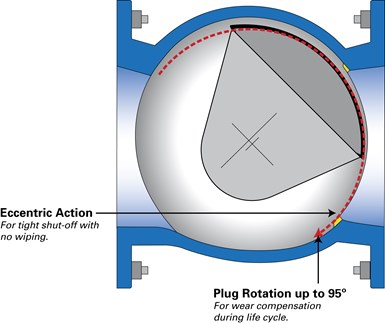
Figure 2: The axis of rotation is offset between the plug and the body seat creating a cam-like opening and closing operation. Source: DeZURIK
Eccentric plug valves are engineered with several innovative features that enhance their performance, reliability and adaptability across a wide range of applications. Available in a broad size range, from small 1/2-inch valves to jumbo 72-inch valves and beyond, these valves are designed to meet the demands of diverse systems and flow requirements. Design features of eccentric plug valves include:
• Off-center rotation: The plug rotates around an axis that is offset from the seat, reducing friction and minimizing wear.
• Cam-action sealing: The eccentric motion presses the plug face into the seat during closure without scraping or sticking.
• Offset plug profile: Eccentric plug valve plugs have an offset profile (see Figure 3) which means the plug is completely out of the flow path when the valve is open. This enables increased flow efficiency while allowing relatively large solids and stringy materials to pass through without clogging.
• Resilient or metal plug facings: Offers flexibility for various applications, with many choices for resilient plug facings providing drip-tight shutoff and metal plugs achieving ANSI/FCI 70-2 Class IV performance.
• Wide range of body materials: Valves are available in cast iron, ductile iron and stainless steel for typical applications. When situations necessitate, special materials like bronze, aluminum and Monel are available.
• Welded seat overlay: The raised, welded-in body seat, normally of nickel, is designed to provide the longest seat life.
• Internal linings: For special environments, valve interiors can be coated with materials including soft rubber lining, glass or Nedox.
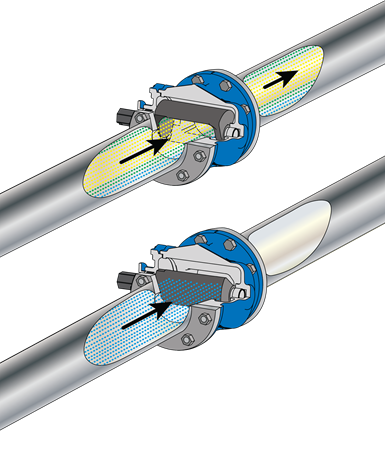
Figure 3: The eccentric plug has an offset profile which provides a full sealing surface but no obstruction to flow when the valve is in the open position. Source: DeZURIK
The design features of the eccentric plug valves are governed by certain industry standards. The standards that should be considered when selecting a valve differ by industry. For the eccentric plug valve in North America, some relevant codes and standards organizations include the American Water Works Association (AWWA), the American Society of Mechanical Engineers (ASME), the Manufacturers Standardization Society (MSS) and the American Petroleum Institute (API). These standards should be considered during the design phase of any project. Some prominent standards that may be of use include:
Eccentric plug valves are a preferred choice for many different applications across industries and applications:
A west coast engineering firm required a reliable control valve for a fish ladder designed to help migratory salmon bypass a dam. The application demanded high flow capacity and the ability to handle high velocity in a 66-in. diameter pipeline with a 6-ft. elevation head differential. After considering multiple valve types, the eccentric plug valve was selected due to its low dynamic torque and resistance to cavitation at velocities up to 38 feet/second.
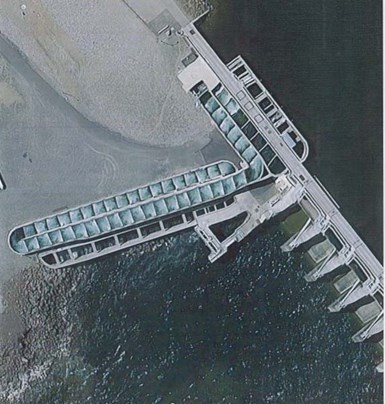
Fish ladders like this are installed to help migratory fish such as salmon bypass dams. Source: DeZURIK
The valve, paired with a gear unit and modulating electric actuator on a 55-ft. extension, was installed with the plug shaft horizontal and seat downstream, flow-to-close, for optimal service life. Unlike other valve designs, which required costly piping modifications, the eccentric plug valve provided a cost-effective, durable solution that met the project’s stringent performance requirements. This valve now ensures proper flow velocity for fish to ascend the ladder, meeting all operational goals and ensuring longevity.
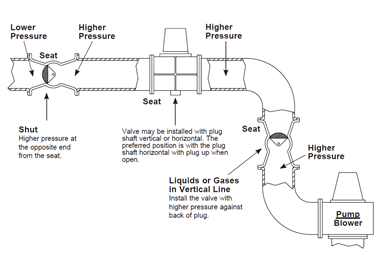
Eccentric plug valves are rugged and, in many applications, will last for decades. To ensure the longest service life possible, certain considerations should be taken during the design phase pertaining to installation orientation. The main factor to consider is what type of media will flow through the valve. Media types can be broken into two main categories:
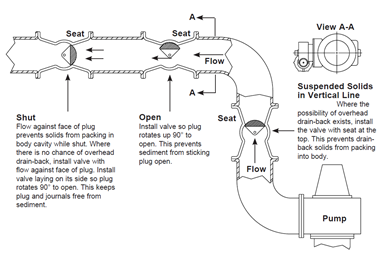
TOP: When pipeline media contains suspended solids, consideration should be given to what happens to the solids when they settle out of the fluid. Source: DeZURIK
BOTTOM: In clean water and gas applications, the valve should be installed in the flow-to-close orientation. Source: DeZURIK
Maintenance for eccentric plug valves is generally simple. Often, the packing gland can be tightened to stop leaks that may occur around the valve stem. If the packing ever needs to be replaced, it can be easily done in the field by maintenance personnel. If the valve does not fully seal when in the closed position, the actuator stops can be adjusted to advance the plug further into the seat. If the plug should ever need to be replaced, the bonnet/cover can be removed while the valve body remains installed in the pipeline.
The eccentric plug valve stands out as a reliable and versatile solution for a broad range of applications. With a wide selection of materials and internal linings to choose from, eccentric plug valves are suitable for many industries including industrial processes, mining and municipal water systems, to name a few. With its proven ability to handle abrasive media, slurries, highly viscous substances like sludge or pitch, and to excel in clean fluid applications, the eccentric plug valve has become a trusted choice across industries. Its longevity, paired with its ease of maintenance, make it a favorite among plant operators and maintenance personnel.
As the demands of modern systems push the limits of size and capacity, the eccentric plug valve continues to demonstrate its ability to meet those challenges, providing operators with a long-lasting and cost-effective solution for their flow control needs.