
Produced by


Published April 27, 2022
The new system will heat and cool buildings with recycled thermal energy from a nearby wastewater pipeline.
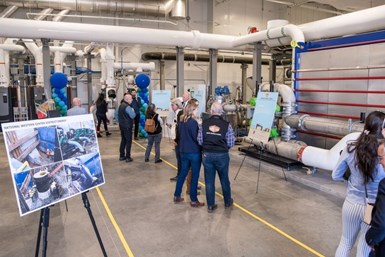
The largest wastewater heat recovery system in the United States has been launched at the National Western Center (NWC). NWC said the system is part of its goal to create a low-carbon campus that’s sustainable and regenerative.
“We made a promise to be at the forefront of sustainability, and we’re delivering,” said National Western Center CEO Brad Buchanan. “Knowing we have to heat and cool our buildings one way or another, we chose an innovative, clean-energy system that’s both beneficial for our campus but also for our community.”
NWC said the wastewater system is housed in an 8,790-square-foot central utility plant constructed of a pre-engineered metal building. In order to build the system, the City and County of Denver’s construction team had to bury a 72-inch wastewater pipeline that once ran alongside the South Platte River, removing its odors and opening up recreational space.
Here’s how the wastewater heat recovery system works:
The system was designed, built and will be operated by EAS Energy Partners (EAS), through an agreement with the NWC. EAS comprises core-competency district energy operator CenTrio, AECOM Technical Services Inc. and Colorado-based Saunders Construction. The original reporting from 9News is here.


September 15, 2026
Effective immediately, CMEI will be divided into three pillars, each of which will be led by a corresponding Deputy Assistant Secretary.
February 2, 2026
First load to be used in reactor at Idaho National Laboratory.
January 7, 2026