
Produced by


Produced by
Published January 28, 2025
Chrome carbide is one coating that can be done during manufacturing or repairs that extends service life of valves and other flow control components.
By Kelly Songer, Precision Spray & Coatings, Director of Valve Services
Valves are a vital component in oil and gas, water treatment, mining and chemical processing, regulating the flow of fluids with high precision and reliability.
Severe service valves are used in the most difficult environments within a process. These severe service environments include erosive, corrosive, high-pressure, high-temperature, and high-velocity media or slurry media.
Over time, valves experience wear leading to costly repairs or replacements. For valves facing severe service conditions, thermal spray coatings like high-velocity oxygen fuel (HVOF) applied coatings, specifically chrome carbide, offer a solution that significantly enhances the performance and longevity of critical components.
HVOF is a thermal spray process that involves spraying molten or heated material onto a surface at high velocity, creating a dense and durable coating. Developed in 1980, HVOF-applied chromium carbide has significantly advanced in the subsequent years, making it a good solution for valves and other components to extend the life of equipment by increasing wear and erosion resistance.

Ball valve component undergoing robotically applied HVOF spray process.
Source: Precision Spray & Coatings
The primary advantage of HVOF chrome carbide coatings is their mechanical bond, which offers superior adhesion compared to other spray processes. Unlike welded overlays, which create a metallurgical bond, HVOF coatings achieve a strong mechanical bond without altering the underlying material’s structure. This helps preserve the integrity of the valve while enhancing its performance.
Chrome carbide is particularly effective due to its exceptional hardness, wear resistance and ability to withstand high-temperature environments. Carbides are primarily used to create a hard surface to resist fretting, wear and erosion and to provide low coefficients of friction. Chrome carbides have an additional function of heat resistance and are generally prescribed for high-temperature applications.
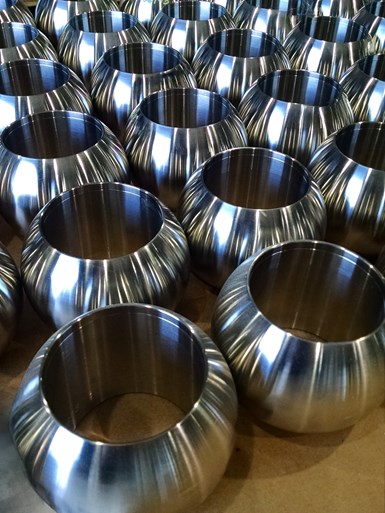
HVOF carbide coating balls for ball valves.
Source: Precision Spray & Coatings
These coatings are commonly applied to valves to enhance their wear resistance, hardness and durability. They provide excellent protection against harsh operating conditions. The dense, tough chrome carbide layer significantly improves the valve’s lifespan by reducing friction and preventing material degradation, making it an ideal choice for critical components exposed to extreme environments. This coating ensures the valves maintain optimal performance and reliability over time.
These characteristics make chrome carbide an ideal coating for valves, such as ball valves, that are subjected to erosive and corrosive conditions.
Many operators choose to repair valves rather than replace them during shutdowns and planned maintenance. During the planned period, experienced vendors can be contracted to complete the repairs within a few weeks.
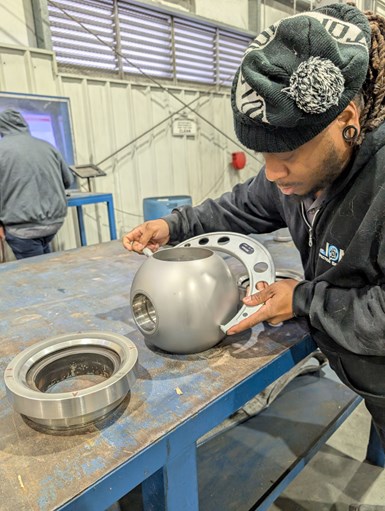
Inspection of chrome carbide-coated and lapped ball and seats.
Source: Precision Spray & Coatings
Valve repairs are a complex process involving the evaluation of components such as the stem, body and seats on all valves, and components such as the ball in ball valves. Soft goods like packing, gaskets and seals must be replaced, while metal parts can often be repaired through welding or coating to restore functionality. Repairing a valve instead of replacing it can save time and money for operators, especially because downtime is costly. The faster a turnaround happens, the faster the plant is returned to service. HVOF coatings can be an essential part of this repair process, restoring damaged surfaces and enhancing valve components’ resistance to wear and corrosion.
When operators choose to finish valves with the addition of HVOF chrome carbide coatings, a valve’s lifespan is extended, minimizing the frequency of repairs and reducing long-term operational costs. The ability to modify and improve the valve during the repair process also provides an opportunity for performance optimization, making this solution even more attractive for industries that require high reliability. If you are an operator, working with a trusted valve repair service provider can save you not only money but time during crucial shutdowns, and can help prevent unscheduled maintenance and repairs in the future.

Kelly Songer is a third-generation industrial manufacturer with more than 20 years experience. In 2016, she was featured as a “Legacy Leader” by the National Association of Manufacturers and in 2017 she was honored with the Service Award from the Valve Manufacturers Association.
Several types of materials can be HVOF coated, and the specific material chosen depends on the desired properties for the application. Here are some of the materials commonly used in HVOF coating:
Metallic Materials
Carbide Materials
Composite Coatings
Other Alloy Materials
Choosing the right material for an HVOF coating is crucial for ensuring the coating meets the performance and durability requirements of the specific application.
Ball valves are a great candidate for HVOF coatings. The repair process for a ball valve begins with the disassembly and evaluation of its individual components. The valve is inspected for signs of wear, the damaged areas are identified, and if the valve is able to be repaired the coating is removed. Grit blasting is used to remove old coatings, paints and any scale buildup before the new coatings are applied to prepare for coating re-application, taking the components back to the base metal.
At this stage the roundness of the ball is verified and it is determined if it is still usable and repairable or must be replaced. Once all components are verified as complete and in spec, the surface is prepared, the HVOF coating process is performed, followed by grinding and lapping to achieve the required surface finish and dimensional tolerance. Grinding is a general abrasive process that refines the valve surface, while lapping is a precision abrasion process used to bring a surface to a desired finish or dimensional tolerance by removing an extremely small amount of material at a time, ensuring a smooth and even finish for a metal-to-metal seal.
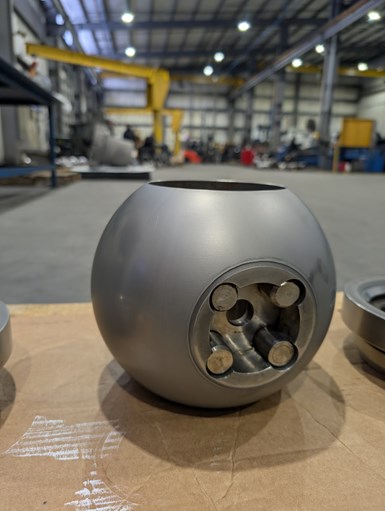
Lapped chrome carbide-coated ball before reassembly.
Source: Precision Spray & Coatings
There are two types of lapping — rough lapping and finish lapping. Rough lapping is used to remove a lot of material quickly, while finish lapping removes an extremely small amount of material at a time to achieve a sealing surface. These processes are critical to ensuring that the ball valve, once repaired, functions as intended, providing a reliable and tight seal to prevent leaks.