
Produced by


Produced by
Published June 26, 2026
Three executives representing manufacturing, distribution and repair share how they are adapting their businesses to internal and external challenges for our industry.
If there is one thing on which the valve industry can agree in 2026, it is this: uncertainty has become…certain. That was a central theme running throughout Valve Forum: Conference & Exhibits and it didn’t escape discussion during the event’s opening panel where three industry leaders offered candid assessments of how they are steering their companies through a time of changes both at home and from abroad including tariffs, geopolitical unrest, succession planning and workforce development and training.
The panelists — Rob Velan, executive vice president of international operations at Velan Inc. and chairman of the VMA board of directors; Scott Jackson, president and CEO of FloWorks; and Chris Jones, vice president at Midwest Valve Services — represent three distinct links in the valve industry value chain. Together, their perspectives painted a picture of an industry under pressure but responding with strategic agility.
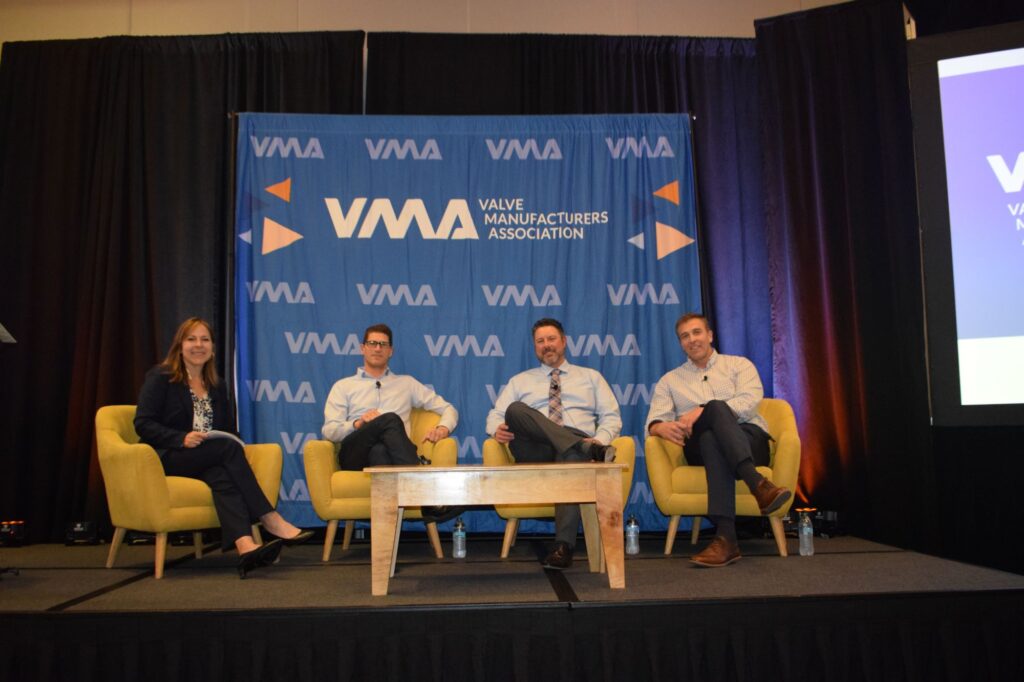
VMA President Heather Rhoderick with VMA Chairman of the Board Rob Velan, VRC Chairman of the Board Chris Jones, Midwest Valve Services VP and Scott Jackson, CEO of FloWorks.
Managing the state of the valve industry today
The panel was moderated by VMA President Heather Rhoderick, who opened by asking the participants for a candid state of the union from each of their perspectives. Despite the companies being in different parts of the same industry, most of their pain points were the same. Dealing with tariffs that could literally be there one day and not the next has a huge impact on operations, especially since suppliers and supply chains aren’t always based in the U.S.
All of the companies represented work globally, either with suppliers or even other subsidiaries of their own companies, which created a lot of chaos starting in March 2025 with President Trump’s Liberation Day tariffs Many other countries responded with reciprocal tariffs so companies have had to manage a coordinated internal response to how they handled this disruption and keep track of a lot more information than normal.
Velan acknowledged the disruption may ultimately prove to be temporary but said the company tweaked its operations to reduce exposure. Notably, Velan and Midwest Valve have both invested in machinery and adding capabilities in house to help minimize some of the disruption. Velan said these upgrades and changes to their manufacturing footprint could remain in place regardless of how tariff policy evolves.
Distributors build redundancy into supply networks
For distributors, the tariff environment has required rapid intelligence-gathering to help customers understand their exposure. Jackson said FloWorks, which operates more than 50 locations across the U.S., Canada and China with over 50,000 inventoried items, moved quickly to map its entire product database by country of origin when new tariff announcements began cascading earlier in the year.
“Our customers were asking what the impact would be on them, and we were quickly able to map out where each product was coming from, whether it was going to be directly affected, and whether the impact would be direct or indirect,” Jackson said.
Jackson described the current environment as one that will likely remain volatile, particularly while the current administration remains in office. Rather than treating each tariff announcement as an isolated event, his team has adopted a posture of treating disruption itself as the new baseline.
“We’ve tried to accept that uncertainty is the new certainty,” he said. “The key for us has been working together as an industry to identify where we can collaborate and say, ‘We’re all facing this same challenge — what are ways we can address it so we become a better industry and find solutions together?'”
Repair sector invests in capability to reduce exposure
Jones, who leads five valve repair facilities across the Upper Midwest and chairs the Valve Repair Council, an affiliate organization of the VMA, said the goal of investing in more in-house machinery and capabilities is to reduce dependence on components that may become unavailable or cost-prohibitive due to trade disruptions
He also noted that the repair sector is benefiting from end users’ growing interest in extending asset lifecycle. With new valve lead times stretched and less predictability with supply chains, more plant operators are turning to valve repair and refurbishment as a cost-effective alternative. Pool programs, when end-users maintain a shared inventory of repaired valves to draw on during turnarounds and outages, are gaining traction as are OEM-certified refurbishment programs that bring a valve back to like-new condition without a full replacement cost.
A bigger risk looming on the horizon
Asked about the single greatest risk facing the valve industry, the panelists agree it’s the uncertainty of tariffs, geopolitics and the impact of wars such as the ones currently taking place in Iran and Ukraine, and the unknown of how long these situations will persist. Since the global pandemic of 2020, companies are also aware that new global crises can arise basically overnight so crisis planning across the enterprise is top of mind.
Jackson echoed the concern, adding that the industry’s greatest vulnerability lies not in any single tariff rate but in how companies react psychologically to ongoing instability. He cautioned against what he described as catastrophizing — an excessive focus on downside scenarios that can paralyze decision-making and erode the collaborative spirit the industry needs to navigate disruption effectively.
“There’s a lot of information out there designed to polarize you and make the world seem like it’s ending,” Jackson said. “My worry is that with all this volatility, people get closed off and stop finding ways to collaborate. But I think this industry has responded well. People are finding ways through these challenges and sharing solutions together.”
Reason for optimism: the world still needs valves
Despite the challenges, the panelists stressed that the valve industry occupies a uniquely resilient position in the broader industrial economy. Jackson noted that demand for flow control products is being driven by a wave of new end markets — data centers, carbon capture, green diesel, hydrogen processing and space applications — alongside continued growth in traditional sectors like oil and gas, power generation and petrochemicals.
“People still need to keep things flowing,” he said. “Through all the ups and downs in history, valves have always been at the center of that. Whether it’s AI, people going to space, data centers — you’re part of that revolution, and there are other industries that cannot say the same.”
Velan pointed to the resurgence of nuclear power, particularly small modular reactors, driven by a rising energy demand globally, as a potentially significant near-term growth opportunity for valve manufacturers. Nuclear is seeing a major revival driven by surging energy demand and a renewed policy focus on baseload, low-carbon generation.
Data centers are an industry showing massive growth right now, with thousands of megawatts planned over the next decade across North America. And flow control for cooling the servers and running HVAC systems for the centers offers great opportunity for valves, pumps and other industrial flow control technologies.
The adaptability imperative
When asked what capabilities will be essential for success over the next three to five years, the panelists converged on two themes: AI adoption and adaptability.
FloWorks has implemented a structured framework for AI use within its organization, using Microsoft Copilot as a core part of their toolset. Jackson believes that utilizing it will help them all be more productive and suggests that all employees use the tools, especially with projects where AI can analyze hundreds of pages of documents that would take hours or days of employees’ time.
Jackson said they have several use cases within the company and are encouraging employees to document their experience and share via word of mouth and in internal chat rooms where they capture their experience. FloWorks has also run company-wide training campaigns to help employees identify practical use cases.
Velan also quoted a recent podcast that reinforced the importance of AI adoption across all sectors — including the more traditional valve industry. “Your job won’t be replaced by AI, it will be replaced by people who understand how to use AI. Further, in the last two years, as machine learning and AI have amped up, it has allowed us to do some work within a week or even within a few days that in the past could have taken weeks.”
Understanding the risks with AI was also cited as an important element of adoption. Companies need to use caution when inputting any proprietary data or intellectual property into any AI system that isn’t a closed-loop system within their infrastructure, much like individuals have learned not to put too many personal identifiers online because it opens risks of hacking and malfeasance. In the case of corporate data, it could open customer data, IP or drawings or anything else stored on company servers and systems.
On the repair side, Jones said Midwest Valve and others in the repair industry are using AI, too. “We as an industry deal with a lot of specifications – everything from a torque spec to what color and type of paint is used on a valve and what the repair process entails so there are so many documents out there we must refer to, including customer specifications. AI allows us to quickly get to the information we need, reducing the time technicians spend hunting for documentation and allowing them to keep working.”
As plants are shortening the duration of shutdowns (sometimes by as much as 50%) and demand faster turnarounds from repair companies, every minute saved can translate to the bottom line. Jones highlighted growing interest among OEMs and end users to take repair information and look for trends. As more data is gathered, Midwest is seeing predictive analytics tools being used to analyze valve failure modes over time, enabling proactive maintenance recommendations for end users.
Workforce challenges and generational differences abound
Jones said that inherently the valve repair industry must convey the important work they do and get potential workers excited about the industry — or even aware of the industry. Jones said repair technicians have always needed mechanical aptitude, and they still do, but it is important that companies learn how to train people who come in without experience. Midwest Valve has taken a different approach to employee learning and development with a stronger focus on education methods, training curriculum, comprehension and career progression planning for the next generation of technicians.
Jackson said that his company is training employees about the value of finding acceptable solutions for customer products, accessories, trim, etc., through shadowing and mentorship but also using data they have on hand to research alternatives to avoid supply chain disruptions and other challenges that arise. They then document these alternatives to help piece together individual items and acceptable substitutes for products.
Velan is taking a slightly different approach and investing in a Subject Matter Expert (SME) program to prevent the loss of institutional knowledge. “When an employee has been with us for many years, sometimes their whole career, and they are getting ready to retire, they have a tremendous amount of knowledge in their heads. We appoint them to an SME role, and for the final years of their career they spend their time overseeing and sharing their knowledge with their team for a smoother transition.” He added, “The knowledge transfer we get from this is invaluable, and it allows them the time to document a lot of that knowledge that has been foundational to them to pass to the next generation.”
Each of these companies has increased investment in training and knowledge capture from existing employees to help build for the future in ways that make sense for their organizations.
For the younger generation entering the valve industry, Velan offered a pointed recommendation to be prepared to keep adapting. “What seems like a traditional industry is actually quite dynamic and starting to change very quickly,” he said. “You have to be able to adapt with it.”
Conclusion
While the three panelists approached the conversation from different perspectives, so much of what they shared was in sync with each other. Embracing change as a new constant and continuing to evolve the way your company works and approaches challenges will be the difference between those who succeed and those that don’t. Using AI and technology to your advantage can be a huge boon to output and knowledge sharing and transfer and help an industry with a base technology that’s been around since the Roman Empire to be a cutting-edge example for manufacturers and industrial companies today and in the future.
VMA’s Valve Forum: Conference & Exhibits takes place next year, May 17-19, 2027, in The Woodlands, TX. It is open to the entire value chain, so save the date to hear firsthand from industry leaders and gain technical, operational and business insights.



October 16, 2026
EPA highlighted PFAS treatment and destruction technologies and announces nearly $1 billion in new funding to states to address PFAS in drinking water.
May 18, 2026
How tariffs, AI and geopolitical risk are fueling a resurgence in areas of manufacturing.
March 18, 2026